
Standard contacts work well for most people, but if you have keratoconus, a corneal irregularity, severe dry eye, or complications from a previous eye surgery, your eyes may need something more. At Round Rock Eyes, our doctors fit scleral lenses and other specialty contacts for patients from Round Rock, Cedar Park, Georgetown, Pflugerville, and the greater Austin area who cannot achieve adequate vision or comfort with conventional lenses.
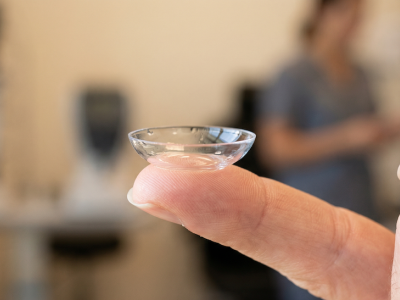
Specialty contact lenses are custom-designed lens systems prescribed when a documented eye condition prevents functional vision through standard glasses or conventional soft contacts.
Many insurance carriers classify these lenses as medically necessary when a qualifying condition is confirmed.
The most commonly prescribed specialty lens is the scleral lens: a large-diameter rigid lens that vaults entirely over the cornea and rests on the white of the eye, the sclera, rather than on the corneal surface.

You may be a candidate if you have any of the following:
Keratoconus or other corneal ectasia (pellucid marginal degeneration, keratoglobus)
Irregular astigmatism from corneal scarring or disease
Complications following LASIK, PRK, or corneal transplant surgery
Severe dry eye disease not adequately managed with drops or in-office treatments
Aphakia (absence of the natural lens) or very high prescriptions
Our doctors will evaluate whether specialty lenses are appropriate for you during a comprehensive exam and corneal mapping.

Scleral lenses are the most commonly prescribed specialty lens for keratoconus and severe dry eye. Unlike standard contacts that rest on the corneal surface, scleral lenses vault completely over the cornea without touching it and rest on the sclera.
The gap between the lens and the cornea is filled with sterile saline solution, creating both a smooth, stable refractive surface for clear vision and a continuous fluid reservoir that keeps the cornea hydrated throughout the day.

Keratoconus is a progressive condition in which the cornea thins and bulges into a cone shape, distorting light in a way that standard glasses and soft lenses cannot correct.
Scleral lenses vault over the irregular surface and use the fluid layer to create a smooth refractive zone, restoring clear and stable vision for many patients.
Other corneal irregularities, including pellucid marginal degeneration, corneal scarring, and post-surgical ectasia, typically respond equally well to scleral lens correction.

For patients with severe dry eye disease, including those with Sjögren's syndrome or ocular surface disease, scleral lenses can provide relief where drops, medications, and in-office treatments have fallen short. The saline reservoir under the lens keeps the ocular surface continuously hydrated.
Scleral lenses are also frequently prescribed for patients experiencing persistent blur, glare, or halos after LASIK, PRK, or radial keratotomy surgery, when standard correction no longer works adequately.
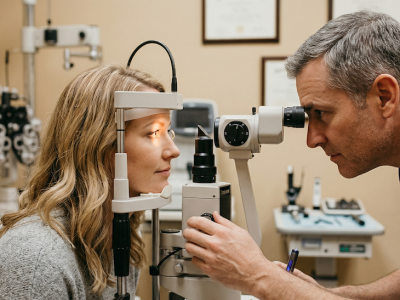
A specialty contact lens fitting is not a single-visit appointment. Here is what to expect:
Comprehensive exam and corneal mapping: Your first visit includes a detailed evaluation of your eye health, visual acuity, and a corneal topography scan that maps the precise shape of your cornea.
Trial lens placement: Based on your corneal map, trial lenses are placed and evaluated for fit, comfort, and optical quality. This may take more than one appointment to get right.
Custom lens order: Once the ideal parameters are confirmed, your lenses are custom ordered. Most specialty lenses are manufactured specifically for your eyes.
Dispensing and training: When your lenses arrive, we walk you through insertion, removal, and care. Scleral lenses require practice to apply correctly, and we make sure you are confident before you leave.
Follow-up: A follow-up visit confirms the final fit on your eyes and gives us a chance to address any adjustments needed.

Specialty contact lenses for qualifying conditions are billed as medically necessary rather than routine vision care.
Many vision insurance plans, including VSP, cover the fitting and the lenses for conditions such as keratoconus and ocular surface disease. Coverage varies significantly by plan and carrier.
We recommend calling your insurance company to verify benefits before your first fitting visit.
We provide documentation of your diagnosis to support your claim.
What is the difference between scleral lenses and regular contact lenses?
Regular soft contacts rest directly on the cornea. Scleral lenses are significantly larger, vault entirely over the cornea without touching it, and rest on the sclera. The space between the lens and the cornea holds a sterile saline reservoir that provides a smooth optical surface and continuous eye hydration throughout the day.
How many visits does a specialty contact lens fitting take?
Most patients need one to two fitting visits before their custom lens is ordered, plus one to two follow-up once the lens arrives. Patients with more complex corneas may need additional visits. Our doctors will give you an estimate at your initial evaluation.
Can scleral lenses help with dry eye disease?
Yes. For patients with significant dry eye that has not responded to drops, medications, or in-office treatments such as IPL or light therapy, scleral lenses can provide substantial relief. The saline reservoir continuously hydrates the ocular surface. This is especially beneficial for patients with Sjögren's syndrome, graft-versus-host disease, or Stevens-Johnson syndrome.
I had LASIK and my vision is still not right. Can you help?
Yes. Post-surgical irregular corneas are one of the more common reasons patients seek specialty lens fittings. If glasses or standard contacts are not correcting your vision adequately after LASIK, PRK, or another procedure, a scleral lens fitting may restore the clear, stable vision you were hoping for from the surgery.
Are specialty contact lenses covered by insurance?
Specialty lenses for qualifying medical conditions are often covered under vision insurance, not medical insurance. Coverage depends on your plan and diagnosis. We recommend calling your carrier before your first visit to confirm benefits.
What is keratoconus and how do specialty lenses help?
Keratoconus is a progressive corneal disease in which the cornea thins and develops a cone-like bulge that distorts vision in a way glasses and standard contacts cannot correct. Scleral lenses vault over the irregular surface and use the fluid layer between the lens and the cornea to create a smooth refractive zone, restoring clear vision for most patients.
Do I need a referral to schedule a specialty lens fitting?
No referral is required. If you have been told by another provider that you are hard to fit, or if standard contacts or glasses are not giving you adequate vision or comfort, you are welcome to schedule a specialty lens evaluation directly with us.
What other lens types are used besides scleral lenses?
Depending on your condition and the severity of your corneal irregularity, our doctors may also evaluate rigid gas permeable (RGP) lenses, hybrid lenses (which combine an RGP center with a soft outer skirt), or piggyback systems (a soft lens worn under an RGP for added cushioning). The best lens type is determined after your corneal mapping and initial trial fitting.
Does Round Rock Eyes serve patients from outside Round Rock?
Yes. We regularly see patients from Cedar Park, Georgetown, Pflugerville, Hutto, and the greater Austin area who need specialty contact lens care. If you have a condition that standard lenses cannot address, we welcome you to schedule a specialty lens consultation with us.
