
Corneal cross-linking (CXL) is a procedure that stabilizes keratoconus, a condition that causes the cornea to thin and bulge into a cone shape over time. Round Rock Eyes plays a critical role in the CXL journey: we detect keratoconus early through corneal topography screening, refer patients to a CXL specialist at the right time, and provide all post-operative monitoring to protect the progress that surgery achieved. We serve patients in Round Rock, Cedar Park, Georgetown, Pflugerville, and the greater Austin area.
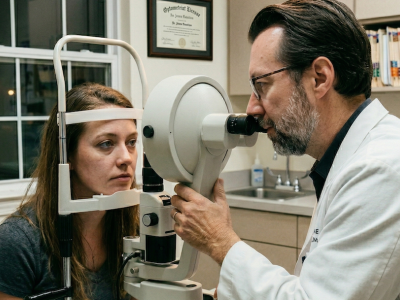
Keratoconus is a progressive eye condition where the cornea (the clear front surface of the eye) gradually thins and steepens into an irregular cone shape. This distorts how light enters the eye and causes vision that cannot be fully corrected with regular glasses. In early stages, specialty contact lenses can provide good functional vision. If the cornea keeps steepening scarring may occur and contact lenses will become harder to fit. Vision will continue to worsen.
Keratoconus often begins in the teens or early twenties and progresses most rapidly during that period. Early detection is essential, the goal is to halt progression before the cornea becomes too irregular to manage well.
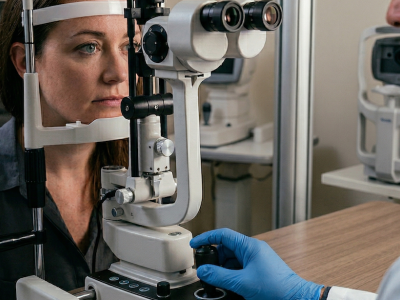
Keratoconus does not always announce itself. In early stages, a patient may simply think their glasses prescription keeps changing, or that one eye is always blurrier than the other. We screen for corneal irregularity at comprehensive eye exams using:
Corneal topography: A detailed map of your corneal surface curvature that can reveal irregular steepening patterns before they cause noticeable vision problems.
Pachymetry: Measurement of corneal thickness to detect focal thinning.
Slit-lamp examination: Visual inspection for physical signs like Vogt's striae (stress lines in the cornea) or Fleischer's ring.
If we find signs consistent with keratoconus, we discuss the findings with you clearly, document a baseline, and monitor closely. If progression is detected on serial topography maps, that is when we discuss a CXL referral.

Corneal cross-linking is the only treatment available to halt or stabilize the progression of keratoconus. It does not reverse existing damage. The procedure works by strengthening the bonds (collagen cross-links) within the corneal tissue.
Riboflavin (vitamin B2) eye drops are applied to the cornea for about 30 minutes to saturate the tissue.
Controlled ultraviolet-A (UV-A) light is then applied to the eye for an additional 30 minutes. The combination of riboflavin and UV-A light triggers new collagen cross-links to form, stiffening the cornea.
The procedure is performed by a corneal specialist, not at Round Rock Eyes. We refer to experienced CXL surgeons in the Austin area when our monitoring indicates the right time for intervention.
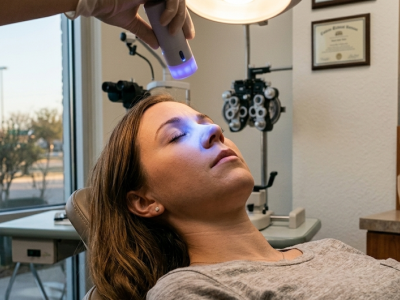
After corneal cross-linking, the cornea goes through a healing process that must be monitored carefully. Round Rock Eyes handles your post-CXL follow-up visits so you do not have to travel back to the surgical center for routine care.
First week: Vision is often blurry and the eye is light-sensitive while the epithelium (surface cell layer) heals. We check healing progress and comfort.
Month 1: Corneal haze is common and expected as part of the healing process. We confirm this is within normal limits and that inflammation is resolving.
Months 3 to 6: Topography is repeated to compare against pre-CXL maps. Most patients show stabilization of corneal curvature readings by this point.
Year 1 and beyond: Annual topography is essential to confirm long-term stability. If any progression is detected on follow-up maps, we communicate with the treating surgeon promptly.
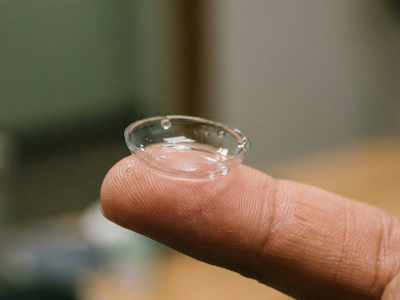
CXL stabilizes keratoconus but does not fully correct the irregular astigmatism. Many patients still need specialty contact lenses after CXL to achieve their best corrected vision.
Scleral lenses are the most common choice. These large-diameter rigid lenses vault entirely over the irregular corneal surface, resting on the white of the eye (sclera) instead. They create a smooth, regular optical surface and are filled with saline, which is especially helpful for patients who also have dry eyes.
Our doctors have experience fitting specialty lenses for keratoconus and post-CXL corneas. We coordinate the timing of your lens fitting with your surgical team to ensure the cornea is sufficiently healed before we begin the fitting process, typically at least 3 to 6 months post-CXL.
How do I know if my keratoconus is progressing enough to need CXL?
Progression is determined by comparing serial corneal topography maps over time. If your steepest corneal reading (Kmax) has increased by a meaningful amount over 6 to 12 months, that typically indicates active progression. We track this and have the conversation about CXL referral when the data supports it.
What is the recovery like after CXL?
The first few days are the most uncomfortable. Most patients experience significant light sensitivity, tearing, and blurry vision while the surface of the eye heals. A bandage contact lens is usually placed at the surgical center and removed at your first post-op visit with us. Vision typically stabilizes over several months as the corneal haze clears.
Will my vision improve after CXL?
CXL is designed to stabilize the cornea, not to improve vision. Some patients do experience a modest improvement in their topography readings over time, but this is not the goal. If you are expecting improved unaided vision, specialty contact lenses are what will achieve that after the cornea has healed.
Can both eyes be treated at the same time?
Some surgeons perform bilateral same-day CXL; others prefer to treat one eye at a time. This is a decision you and your CXL surgeon will make together. We coordinate post-op care for both eyes regardless of timing.
Does insurance cover CXL?
CXL is FDA-approved for progressive keratoconus in the United States. Many major medical insurance plans cover it when documented progression is present, though prior authorization is often required.
I was told I have keratoconus at another practice. Can I switch my care to Round Rock Eyes?
Yes. We are happy to take over your monitoring care. Please bring your prior topography records so we have a baseline to compare against. If CXL has already been performed, we can step in to provide all post-operative follow-up and specialty lens fitting.
