
Glaucoma has no early symptoms, and vision lost to it cannot be restored. At Round Rock Eyes, we use advanced diagnostic technology to detect and manage glaucoma early, before it affects your quality of life. With over 25 years serving Round Rock, Cedar Park, Georgetown, and Pflugerville, our doctors go beyond the standard of care to protect your sight.

Glaucoma is a group of eye conditions that damage the optic nerve, most often caused by elevated pressure inside the eye. It rarely causes pain or noticeable symptoms in its early stages, and peripheral vision is typically the first to go.
Because we naturally compensate for peripheral vision loss, most patients do not notice anything until the disease has progressed significantly.
Vision lost to glaucoma cannot be restored, which is why regular testing matters even when your eyes feel fine.

Open-Angle Glaucoma is the most common form. The eye's drainage channels become gradually less efficient over time, causing pressure to build slowly and painlessly. It is frequently undetected without regular testing.
Normal-Tension Glaucoma causes optic nerve damage even when eye pressure is within a normal range. It can be missed if testing focuses on pressure alone, which is one reason we evaluate the optic nerve directly with OCT imaging.
Angle-Closure Glaucoma is less common but can be a medical emergency. A sudden blockage of the drainage angle causes a rapid pressure spike with symptoms including eye pain, blurred vision, headache, and nausea. It requires urgent care.

You should schedule a glaucoma evaluation if you:
Are 60 years of age or older (or over 40 if you are African American)
Have a family history of glaucoma
Have elevated eye pressure or thin corneas
Have diabetes, high blood pressure, or cardiovascular disease
Are significantly nearsighted or farsighted
Have had a previous eye injury or eye surgery
Have been on long-term steroid medications
If you have one or more of these risk factors, annual glaucoma testing is important regardless of whether you have any symptoms.
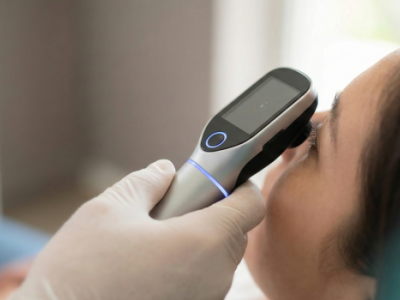
Many patients dread the traditional air puff test. At Round Rock Eyes, we use the iCare tonometer, which eliminates it entirely.
The iCare measures eye pressure using a tiny probe that makes brief, gentle contact with the eye surface. No numbing drops are required, and most patients barely feel it. It is accurate, fast, and comfortable for all ages, including patients who have avoided glaucoma testing because of the air puff.
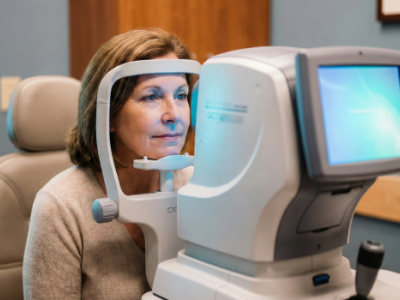
OCT imaging is one of the most powerful tools available for detecting early glaucoma. At Round Rock Eyes, we perform OCT scans on every routine eye exam where digital imaging is requested, using it as a yearly screener even for patients without known glaucoma.
Our OCT measures the optic nerve and the ganglion cell complex, detecting structural changes years before they become visible through conventional examination. Baseline measurements taken early give us objective data to track progression over time and adjust your plan before damage becomes significant.
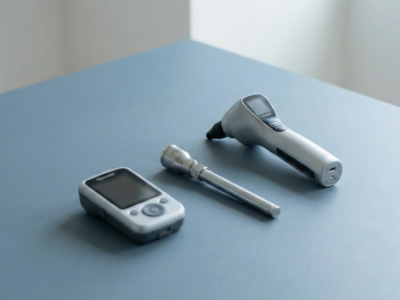
A thorough glaucoma evaluation requires more than a pressure check. Our complete assessment includes:
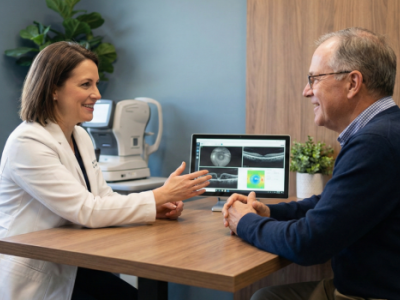
Glaucoma cannot be cured, but it can be controlled. For most patients, treatment begins with prescription eye drops to lower intraocular pressure. Our doctors work with you to find the right medication, monitor its effectiveness, and make sure you know exactly how to use it.
Glaucoma requires consistent long-term monitoring. Diagnosed patients are typically seen every three to six months depending on the stability of their condition. When laser treatment or surgery is needed, we coordinate closely with trusted ophthalmologists in the Round Rock and Austin area.
How often should I be tested for glaucoma?
If you have no risk factors, a baseline evaluation is recommended by age 40, with follow-up every two to four years. With risk factors, annual testing is appropriate. Diagnosed patients are typically seen every three to six months.
Can glaucoma be cured?
No. Vision lost to glaucoma cannot be restored, and there is no cure. However, it can be effectively controlled to prevent further loss. Patients diagnosed early who manage their condition consistently typically maintain good functional vision.
Does glaucoma always cause high eye pressure?
No. Normal-tension glaucoma damages the optic nerve even with normal pressure readings. This is why we evaluate the optic nerve directly with OCT rather than relying on pressure alone.
What does the glaucoma test feel like?
Our primary pressure test uses the iCare tonometer. There’s no air puff, no numbing drops, it’s barely noticeable. OCT imaging and visual field testing are completely non-invasive and painless.
Is glaucoma testing covered by insurance?
Yes. Most plans, including Medicare, cover glaucoma testing for at-risk patients. Monitoring visits for diagnosed patients are typically covered as medical visits. We recommend confirming your coverage before your appointment, and our team is happy to help.
What is the difference between glaucoma testing and a regular eye exam?
A standard exam may include a basic pressure check, but not the full evaluation we provide. Our glaucoma assessment adds OCT imaging, visual field testing, pachymetry, and gonioscopy, allowing us to detect glaucoma significantly earlier than a routine exam would.
Do you see glaucoma patients from outside Round Rock?
Yes. We regularly see patients from Cedar Park, Georgetown, Pflugerville, Hutto, and the greater Austin area. Round Rock Eyes is located at 481 Sundance Pkwy in the La Frontera Shopping Center, Round Rock, TX 78681. Call us at 512-255-9995 or schedule your evaluation online.

Protecting your vision starts with a baseline. If you are in Round Rock, Austin, Georgetown, or the surrounding areas and are over 40, have risk factors, or simply want the most advanced eye care available, contact us today.
📞 Call Round Rock Eyes at (512) 255-9995
📍 Visit Our Clinic:
Round Rock Eyes
481 Sundance Pkwy, Suite 100
Round Rock, TX 78681
(Get Directions)
